


















-

In Silico Studies of HIV-1 Vpr R77Q Mutant’s Structure and Stability
Linnea Mason, Sidney T. Sithole, and Bradford K. Berges
Human immunodeficiency virus type 1 (HIV-1) is a retrovirus that infects CD4+ T cells. Without treatment, infection with HIV-1 usually leads to acquired immunodeficiency syndrome (AIDS), which is characterized as severe immunosuppression (CD4+ count: < 200cells/mm3 of blood). However, some individuals do not advance to AIDS and are known as long-term non-progressors (LTNP). Interestingly, a small viral protein of HIV-1, called viral protein R (Vpr), has been associated with HIV-1 progression. The R77Q mutant has been linked to the LTNP phenotype and increased levels of apoptosis; however, the mechanisms behind it are not yet understood [1]. Previously, our group has found that Vpr was expressed at lower levels in cells infected with R77Q virus compared to the wildtype (WT) virus by western blot [1]. Image quantification of the bands showed an approximate six-fold reduction in protein levels.
-

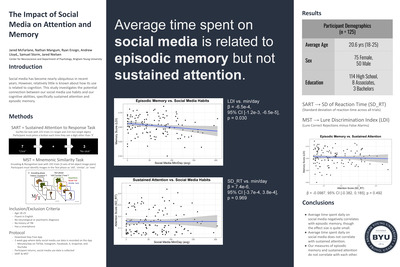
The Impact of Social Media on Attention and Memory
Jared McFarlane, Nathan Mangum, Ryan Ensign, Andrew Lloyd, Samuel Storm, and Jared Nielsen
Social media has become nearly ubiquitous in recent years. However, relatively little is known about how its use is related to cognition. This study investigates the potential connection between our social media use habits and our cognitive abilities, specifically sustained attention and episodic memory.
-

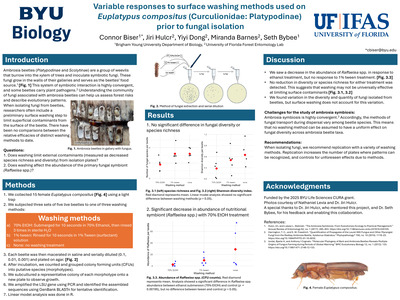
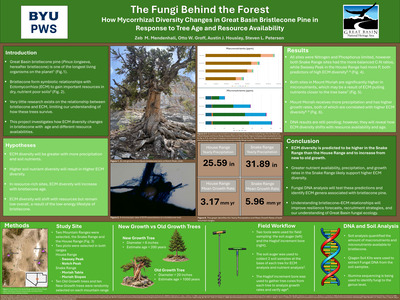
The Fungi Behind the Forest: How Mycorrhizal Diversity Changes in Great Basin Bristlecone Pine in Response to Tree Age and Resource Availability
Zeb M. Mendenhall, Otto W. Groff, Austin J. Housley, and Steven L. Petersen
2nd Place - Open House Presentation
Great Basin bristlecone pine (Pinus longaeva, hereafter bristlecone) is one of the longest living organisms on the planet1 (Fig.1).
Bristlecone form symbiotic relationships with Ectomycorrhiza (ECM) to gain important resources in dry, nutrient poor soils2 (Fig. 2).
Very little research exists on the relationship between bristlecone and ECM, limiting our understanding of how these trees survive.
This project investigates how ECM diversity changes in bristlecone with age and different resource availabilities.
-
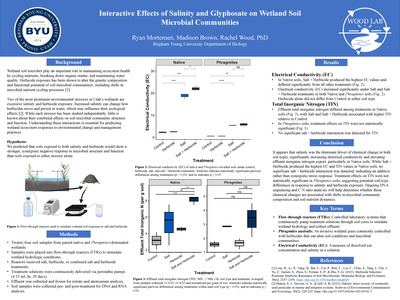
Interactive Effects of Salinity and Glyphosate on Wetland Soil Microbial Communities
Ryan Mortensen, Madison Brown, and Rachel Wood
Wetland soil microbes play an important role in maintaining ecosystem health by cycling nutrients, breaking down organic matter, and maintaining water quality. Herbicide exposure has been shown to alter the genetic composition and functional potential of soil microbial communities, including shifts in microbial nutrient cycling processes [1].
Two of the most prominent environmental stressors in Utah’s wetlands are excessive salinity and herbicide exposure. Increased salinity can change how herbicides move and persist in water, which may influence their ecological effects [2]. While each stressor has been studied independently, little is known about their combined effects on soil microbial community structure and function. Understanding these interactions is essential for predicting wetland ecosystem responses to environmental change and management practices.
-
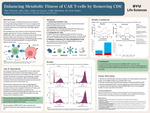
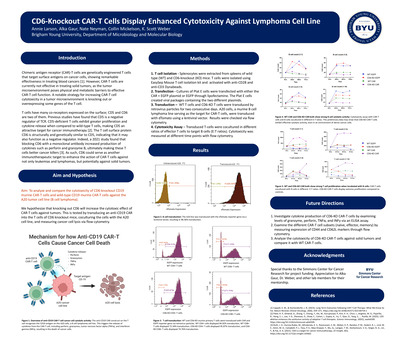
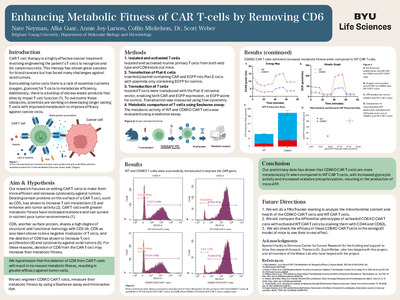
Enhancing Metabolic Fitness of CAR T-Cells by Removing CD6
Nate Neyman, Alka Guar, Annie Joy-Larson, Collin Mickelson, and Scott Weber
Honorable Mention - Poster Design
CAR T-cell therapy is a highly effective cancer treatment involving engineering the patient’s T-cells to recognize and kill cancerous cells. This therapy has shown great success for blood cancers but has faced many challenges against solid tumors.
Surrounding tumor cells there is a lack of essential nutrients (oxygen, glucose) for T-cells to metabolize efficiency. Additionally, there is a buildup of excess waste products that directly impair T-cell function (1). To overcome these obstacles, scientists are working on developing longer lasting T-cells with improved metabolism to improve efficacy against cancer cells.
-

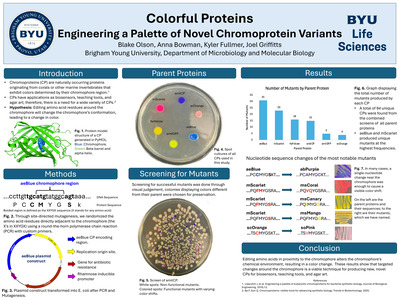
Colorful Proteins: Engineering a Palette of Novel Chromoprotein Variants
Blake Olson, Anna Bowman, Kyler Fullmer, and Joel Griffitts
2nd Place - Poster Design
- Chromoproteins (CP) are naturally occurring proteins originating from corals or other marine invertebrates that exhibit colors determined by their chromophore region.1
- CPs have applications as biosensors, teaching tools, and agar art; therefore, there is a need for a wide variety of CPs.2
- Hypothesis: Editing amino acid residues around the chromophore will change the chromophore’s conformation, leading to a change in color.
-

Uncovering the Roles of Environment and Phylogeny in the Expression of a Shared Morphological Trait in Squamates
Austin Rejcek, Dylan McMullen, Logan Gren, and Randy L. Klabacka
Addressing the roles of adaptive and nonadaptive processes in trait evolution is a major focus of evolutionary biology
Recently, we observed an undescribed morphological trait on the eyelids of squamate lizards - AKA ''Palpebral combs'' (See photos)
This trait appears to be widespread within lguania, although there is consistent morphological variation between species of varying ecologies
-

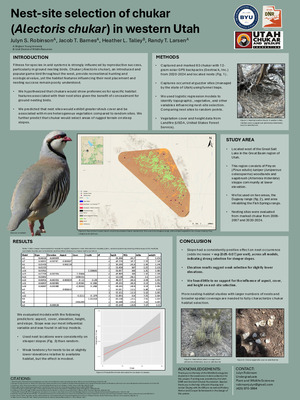
Nest-Site Selection of Chukar (Alectoris chukar) in Western Utah
Julyn S. Robinson, Jacob T. Barnes, Heather L. Talley, and Randy T. Larsen
Fitness for species in arid systems is strongly influenced by reproductive success, particularly in ground nesting birds. Chukar (Alectoris chukar), an introduced and popular game bird throughout the west, provide recreational hunting and ecological value, yet the habitat features influencing their nest placement and nesting success remain poorly understood.
-

Interspecific Dynamics of Whitebark and Great Basin Bristlecone Pines in Nevada’s Ruby Mountains
Mayzie Ruggles, Sydney Jones, Zeb Mendenhall, Julyn Robinson, and Steve Petersen
High-elevation five-needled pines are keystone species in mountain ecosystems, where they provide critical wildlife habitat, stabilize soils, and retain snowpack that prolongs streamflow downstream. As temperatures rise in response to climate change, these long-lived conifers face increasing pressures from wildfire, disease, and bark beetles. Understanding their interspecific interactions has become essential for conservation and effective forest management by determining if pine species compete with each other or facilitate each others growth and survival. The Ruby Mountains of northeastern Nevada represent the only known location where Great Basin bristlecone pine (Pinus longaeva) cooccur with whitebark pine (Pinus albicaulis). Despite the ecological significance of these long-lived, high-elevation conifers, their potential interactions have never been studied. Findings from this study will provide critical insight for understanding conditions of coexistence and competition, directly informing conservation and restoration strategies for both species as they face accelerating climate and disturbance pressures.
-

Unlikely Relationships: Plant Growth Promotion With Fish Waste Microbes
Thomas W. Scharf and Brad Geary
1st Place - Open House Presentation
- Aiding plant growth is becoming more important as climate conditions continue changing in key wildlands and farmlands.
- Future Fresh Farms has created a product from fish waste, addressing this need.
- This study aimed to compare the outcomes of plants grown with MicroRevive, derived from fish waste, against plants grown with other growth promoting bacteria (PGPB).
-
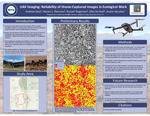
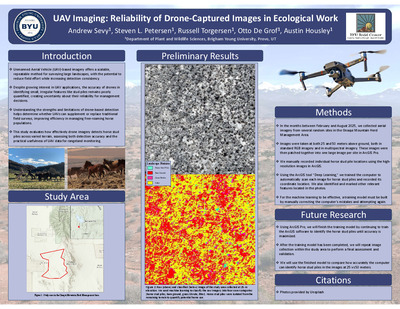
UAV Imaging: Reliability of Drone-Captured Images in Ecological Work
Andrew Sevy, Steven L. Petersen, Russell Torgersen, Otto De Grof, and Austin Housley
Unmanned Aerial Vehicle (UAV)-based imagery offers a scalable, repeatable method for surveying large landscapes, with the potential to reduce field effort while increasing detection consistency.
Despite growing interest in UAV applications, the accuracy of drones in identifying small, irregular features like stud piles remains poorly quantified, creating uncertainty about their reliability for management decisions.
-

Ketone Bodies May Mitigate Metabolic Dysfunction in a Model of Migraine
T. Luke Shafer, Dallin S. Nevers, Rachel Ricks, Clayton Dunford, Tyler Poulos, Isaac Stubbs, Coleson Cheney, Benjamin T. Bikman, and R. Ryley Parrish
Honorable Mention - Open House Presentation
- Spreading depolarization (SD) is a slow-moving wave of ionic redistribution.
- SDs propagate through cortical tissue in patients experiencing migraine with aura, as well as traumatic brain injury (TBI), ischemic stroke, and seizure.
- Recovery of ionic homeostasis following SD is metabolically taxing; an energetic deficit is associated with long-term mitochondrial damage.
- Ketone body supplementation is a promising therapeutic for epilepsy and migraine, although its mechanisms are not fully understood.
-

Derivation and Validation of Age-Associated Prognostic Gene Signatures Across Breast Cancer Subtypes
John Speers, Adrienne Parsons, Elizabeth Feliciano, Sandra McAllister, and Lindsey Hale
Relatively little research has been done investigating the effects of linear age on breast-cancer specific mortality . The development of age-associated gene signatures may reveal interesting gene-set patterns with therapeautic potential. We hypothesize that the separation of patients into age categories will yield more predictive gene-signatures than an age-agnostic approach.
-

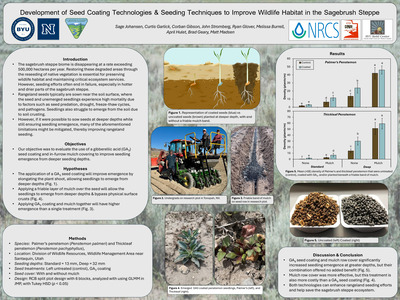
Improving Native Grass Germination With Seed Enhancement Technologies
Ronni Stauffer, Tanner Knapp, April Hulet, and Matthew Madsen
Faster germination aids invasive weeds’ competitive ability.
Several different seed enhancement technologies can help improve native grass germination.
Osmotic priming, solid matrix priming, and gibberellic acid (GA3) seed coatings are different techniques that have been shown to increase seedling germination in native plants.
-

Three Lower Extremity Muscle Volumes Predict Countermovement Jump Height in Collegiate Basketball Players
Josh Vandenakker, Jacob Green, Malorie Wilwand, Micahel Davie, Steven D. Arnold, and A. Wayne Johnson
The countermovement jump (CMJ) is an essential ability in basketball, and increased jump height provides players with a competitive advantage.
Sport-specific data connecting MRI-derived muscle volumes to CMJ mechanics and height remains limited.
Our aim: To examine correlations between CMJ height and the muscle volume of the soleus, quadriceps, and gluteus maximus in collegiate basketball players.
-

Seizure Propagation and How Ketones May Help Mitigate Harmful Effects
Jacob Wassmer, Melissa L. Blotter, Isaac Stubbs, and R. Ryley Parrish
Status epilepticus (SE) is a seizure state characterized by continuous ictal activity lasting over 5 minutes. SE frequently becomes unresponsive to frontline antiepileptic drugs (AEDs), resulting in refractory status epilepticus (RSE), a neurological medical emergency with a mortality rate as high as 38% in some studies. To assess how SE develops over time, we have characterized an ex vivo brain slice SE model using a high-resolution multi-electrode recording system. The system contains over 4000 electrodes with less than 60μM of space in between each electrode. With this unprecedented spatial and temporal resolution, we have identified key features of SE that may help us understand its patterns of propagation as well as possible methods of preventative treatment. Our findings point to SE recruiting tissue and spreading in a modular pattern, with newly recruited regions becoming new ictogenic drivers (ictal cores) of further SE activity.
-

Investigating the Role of TNF in HIV-1 Infected Cell Death
Brennan B. Wells, Sidney Sithole, and Bradford Berges
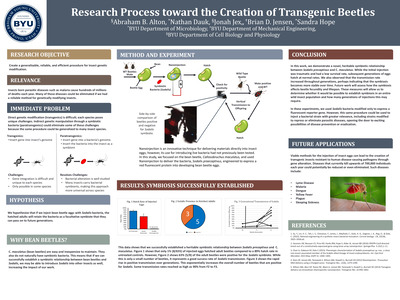
HIV-1 is the causative agent of the terminal disease AIDS. Clinical studies have determined that patients infected with a mutant of HIV-1, Vpr-R77Q, do not progress towards AIDS. Subsequently, our lab has discovered two notable differences between the Vpr- R77Q variant and WT HIV-1: increased levels of apoptosis in infected cells (which is thought to contribute to the lack of AIDS progression), and decreased levels of inflammatory cytokines, namely Tumor Necrosis Factor (TNF). The purpose of this ongoing experiment is to investigate the potential inverse correlation between TNF levels and apoptosis levels through the introduction of additional TNF cytokines to an infected system and flow cytometry analysis
-

Potential Role of ATR in Slower AIDS Progression Associated With HIV-1 Vpr Mutant R77Q
Ava Wilstead, Sidney T. Sithole, and Bradford K. Berges
HIV-1 typically induces necrotic T cell death, resulting in chronic inflammation that drives Acquired Immunodeficiency Syndrome (AIDS) progression. However, mutations in viral protein R (Vpr) are associated with altered disease outcomes. The HIV-1 Vpr mutant R77Q is linked to individuals that do not progress to AIDS without treatment, termed a longterm non-progressor (LTNP). The Berges lab has shown that R77Q infection results in reduced overall cell death compared to wild-type (WT) virus, while inducing increased apoptotic cell death.
Printing is not supported at the primary Gallery Thumbnail page. Please first navigate to a specific Image before printing.