


















-

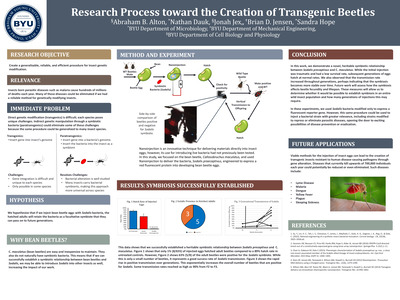
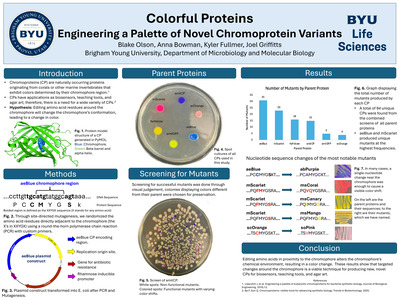
Research Process Toward the Creation of Transgenic Beetles
Abraham B. Alton, Nathan Dauk, Jonah Jex, Brian D. Jensen, and Sandra Hope
Honorable Mention - Poster Design
Create a generalizable, reliable, and efficient procedure for insect genetic modification.
Insects born parasitic diseases such as malaria cause hundreds of millions of deaths each year. Many of these diseases could be eliminated if we had a reliable method for genetically modifying insects.
-

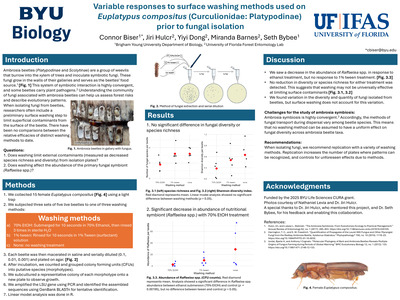
Variable Responses to Surface Washing Methods Used on Euplatypus compositus (Curculionidae: Platypodinae) Prior to Fungal Isolation
Connor Biser, Jiri Hulcr, Miranda Barnes, and Seth Bybee
Ambrosia beetles (Platypodinae and Scolytinae) are a group of weevils that burrow into the xylem of trees and inoculate symbiotic fungi. These fungi grow in the walls of their galleries and serves as the beetles’ food source.1 [Fig. 1] This system of symbiotic interaction is highly convergent, and some beetles carry plant pathogens.2 Understanding the community of fungi associated with ambrosia beetles can help us assess forest risks and describe evolutionary patterns. When isolating fungi from beetles, researchers often include a preliminary surface washing step to limit superficial contaminants from the surface of the beetle. There have been no comparisons between the relative efficacies of distinct washing methods to date.
-

Species Dynamics and Potential Invasion in the Restored Streams of East Maui
Hannah Breinholt, Isabelle Hunter, Sarah Cole, Seth M. Bybee, and Rachel L. Wood
100+ years of water diversions in East Maui disrupted this connectivity, threatening native species and their habitat
In 2018, stream flow was restored to 22 streams
Endemic amphidromous fish in East Maui streams depend on intact flow from mountains to sea (mauka-to-makai) and are especially vulnerable to habitat disruption and isolation [1]
Has stream restoration enabled native fish species to recolonize or has it created openings for non-native species?
-

Describing Soil Water Dynamics in a Kenyan Essential Oil Tree Orchard: Analyzing a Year of Data to Diagnose Water Management Difficulties
Sarah C. Campbell, Katherine A. Anselmi, Bryan G. Hopkins, Jacob Katuva, and Neil C. Hansen
In recent years, the demand for essential oils has increased as many people have begun to prefer more natural and organic remedies. Essential oil production provides unique potential income opportunities for small-holder farmers in the developing world. One type of oil is a tree crop called Ylang-ylang (Cananga odorata) where oil is extracted from flowers harvested from trees daily. A Ylang-ylang orchard in Kenya has been experiencing water management challenges during both rainy and dry seasons.
-

The Role of NMDA and mGluR5 Receptors on Hippocampal Depotentiation
J.H. Cummings, E. Sandberg, and J.G. Edwards
Depotentiation of LTP, the cellular mechanism of learning and memory, is thought to be the primary mechanism of forgetting.
Prior research in our lab investigated metabotropic glutamate receptor 5 (mGluR5) and its role in depotentiation and noted differences between males and females.
Preliminary data on NMDA receptors using AP5 (an antagonist) identified interesting findings, though n values are too low currently to draw conclusions.
-

Muscle Transplants: Science Fiction or Modern Medicine?
Erastus Evans, Mason Kephart, Benjamin Long, and Jake Sorensen
The loss of skeletal muscle from trauma or surgery results in limited regeneration and long-term dysfunction. Muscle transplants replenish lost cellular and structural tissue to improve healing and recovery of strength. Juvenile tissue offers a promising alternative to adult tissue due to the increased satellite cell and myofiber content.
-

The Web Hunter: Gut Metabarcoding of Thread Legged Assassin Bugs (Emesinae; Reduviidae)
Julia Fordham and Samantha Standring
Thread-legged assassin bugs (Emesine) have frequently been observed on Baguada giganteus spider webs and have specialized morphology thought to evolve from hunting spiders. There is little to no research regarding the diet preferences for the majority of Emesinae species, and it remains unclear to what extent their diet consists of spiders. This research project utilized gut metabarcoding techniques to better understand the dietary behaviors of four emesine species: Emesa annulata, Polauchenia schubarti, Tagalis dichroa, and Bagauda giganteus.
-

Collegiate Basketball Athletes' Achilles Tendon Echogenicity Decreases Over a Season With No Difference in Size
Colton Glissmeyer, Malorie Wilwand, Camille Nguyen, Michael Davie, and A. Wayne Johnson
3rd Place - Open House Presentation
- The Achilles tendon (AT) enables movements essential to athletes.
- Early AT injury indicators include increased cross-sectional area (CSA), thickening, and decreased echogenicity.
- This study investigated the change in AT CSA, thickness, and echogenicity in collegiate basketball athletes across one season.
-

Shoot Apical Meristem Size and Inflorescence Morphology in Gilia
Madeleine Glover and Clinton Whipple
Gilia, a genus of wildflower native to the western United States, is a promising new model for evolutionary developmental biology. Two closely related Gilia species, G. capitata and G. yorkii, are able to produce a fertile hybrid, though they differ in many morphological features, including inflorescence architecture. G. capitata has a tight capitate inflorescence with a high solitary flower number, while G. yorkii has a much more open inflorescence, with a solitary flower number of one. Analysis of shoot apical meristem (SAM) size in relationship with solitary flower number (SFN) will provide a deeper understanding of the evolution of this morphological divergence.
-

Exploring the Impact of Redox Perturbations on Optic Tectum Development and Behavior
Kevin Gray, Bailey Calder, Daniel Andersen, Parker Hamblin, Michael Zeyer, and Arminda Suli
The optic tectum (OT), the non-mammalian counterpart of the mammalian superior colliculus (SC), integrates multisensory information and orchestrates behavioral responses such as reflexive movements and attention shifts. It is localized in the midbrain, where anterior-posterior patterning is regulated by transcription factors dependent on proper endogenous H2O2 levels. Recent studies have implicated the OT/SC and early redox imbalance in neurodevelopmental disorders such as autism spectrum disorder (ASD). Given the importance of H2O2 in midbrain development, we are investigating how redox perturbations may lead to atypical OT circuitry development and, subsequently, result in aberrant behavioral phenotypes, similar to those associated with ASD. When we previously exposed zebrafish embryos to valproic acid (VPA), a drug associated with a higher incidence of ASD and known to induce redox stress, we observed hyperactivity and increased anxiety. However, whether these effects are specific to possible redox stress in the OT remains unclear. To address this, we will induce targeted redox changes in the OT using the nitroreductase-metronidazole (NTR-MTZ) system at levels that do not induce apoptosis. Additionally, we will modulate redox effects by inhibiting key redox regulators nrf2a, keap1a, and keap1b. In brief, the transcription factor nrf2a activates antioxidant genes in response to reactive oxygen species (ROS), but is ubiquitinated by keap1a/b when ROS is absent. We anticipate that a nrf2a knockout will potentiate ROS effects, while keap1a/b knockouts will mitigate ROS effects. Subsequent behavioral assays will elucidate the impact of OT-specific redox changes, offering insights into the interplay between redox states, OT development, and behavioral outcomes.
-

Reducing the Cost of Muscle Volume Research
Jacob Green, Josh Vandenakker, Malorie Wilwand, Micahel Davie, Steven D. Arnold, and A. Wayne Johnson
Honorable Mention - Open House Presentation
PROBLEM: Current MRI segmentation options consist of manual segmentation, requiring up to 6 hours per subject, or using segmentation companies that charge about 400$ per MRI.
-

Discovery of Short Antimicrobial Peptides in a Periplasmic Expression System
Joel Griffitts, Adam Dunn, Caleb Parker, and Matthew Steed
Short Antimicrobial peptides (sAMPs) have the potential to make a significant impact in the ongoing battle against antibiotic-resistant bacteria. In this project, we aim to discover new sAMPs using a novel peptide expression system in E. coli. Using this system, we have successfully identified various sAMPs by testing both rationally designed peptides and randomized peptide libraries.
-

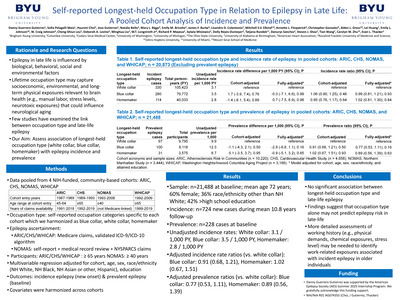
Self-Reported Longest-Held Occupation Type in Relation to Epilepsy in Late Life: A Pooled Cohort Analysis of Incidence and Prevalence
Daniel Guerrero Gutierrez, Sofia Pelagalli Maia, Hyunmi Choi, Jose Gutierrez, Natalie Bello, Mary L. Biggs, Emily M. Briceño, James F. Burke, Lisandro D. Colantonio, Mitchell S.V. Elkind, Annette L. Fitzpatrick, Christopher Gonzalez, Alden L. Gross, Lei Huang, Emily L. Johnson, W. Craig Johnson, Cheng-Shiun Leu, Deborah A. Levine, Minghua Liu, W.T. Longstreth Jr., Richard P. Mayeux, Sylwia Misiewicz, Dolly Reyes-Dumeyer, Tatjana Rundek, Danurys Sanchez, Steven J. Shea, Tian Wang, Carolyn W. Shu, and Evan L. Thacker
Epilepsy in late life is influenced by biological, behavioral, social and environmental factors
Lifetime occupation type may capture socioeconomic, environmental, and long-term physical exposures relevant to brain health (e.g., manual labor, stress levels, neurotoxic exposures) that could influence neurological aging
-
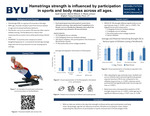
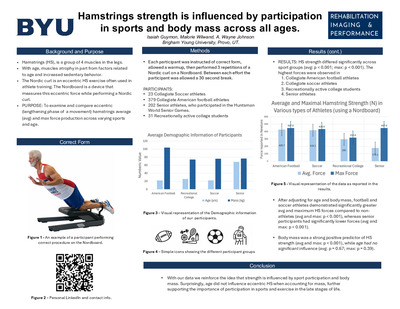
Hamstrings Strength Is Influenced by Participation in Sports and Body Mass Across All Ages
Isaiah Guymon, Malorie Wilwand, and A. Wayne Johnson
Hamstrings (HS), is a group of 4 muscles in the legs.
With age, muscles atrophy in part from factors related to age and increased sedentary behavior.
The Nordic curl is an eccentric HS exercise often used in athlete training. The Nordboard is a device that measures this eccentric force while performing a Nordic curl.
PURPOSE: To examine and compare eccentric (lengthening phase of a movement) hamstrings average (avg) and max force production across varying sports and age.
-

Genetic and Morphological Comparison Between Introduced and Native Populations of Aspidocelis Neomexicanus
Sadie Hale, Jordan Kirk, Arianna Moore, Perry Van Wagoner, Vicente Fernández Lara, Angelina Romero, Dallin Matthews, Álvaro Osuna Jiménez, Reagan McKee, and Randy Klabacka
The introduction of non-native species to novel ecosystems can have negative impacts on the environment, economy, and human health.
Understanding the processes driving patterns in dispersion, establishment, and expansion of introduced species can illuminate strategies to reduce the occurrence of introduction and mitigate its effects.
The New Mexico Whiptail (Aspidoscelis neomexicanus) is a parthenogenetic (asexually-reproducing) species of lizard in the family Teiidae.
-

The Story Behind the Waves: Effects of Urbanization and Female Presence on Waving Behavior in Fiddler Crabs
Katelyn Hansen and Blaine Griffen
Animal communication plays a central role in survival and reproduction, allowing individuals to convey information about their quality, territory, and reproductive statuses. Because signaling behaviors are often energetically costly and are dependent on both social contexts and habitat, they are sensitive to environmental conditions. Previous research has shown that male sand fiddler crabs (Leptuca pugilator) produce two distinct wave types: D-waves (typically directed towards other males) and up-and-down waves (typically directed toward females), and that they also reduce their waving behavior under urban stress. Urbanization introduces stressors such as habitat alteration and increased disturbances that can change the frequency and type of signaling fiddler crabs produce. This study combines those findings by comparing urban and rural sites to determine whether wave rate and wave type differ across habitats, as well as in the presence of females. Understanding these patterns provides insight into how animals adjust their communication strategies in response to human altered environments. This work contributes to the broader understanding of the behavioral plasticity in this species as well as how anthropogenic stressors can influence ecological and social interactions in coastal organisms.
-
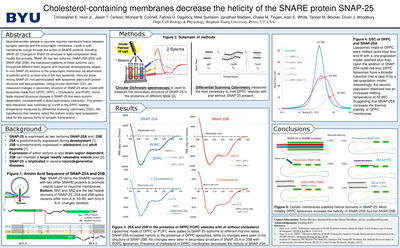
Cholesterol‑Containing Membranes Decrease the Helicity of the SNARE Protein SNAP‑25
Christopher E. Hunt Jr., Jason T. Carlson, Michael B. Connell, Fatima D. Dagohoy, Mike Sumison, Jonathan Madsen, Chase M. Tingen, Azer E. White, Tanner M. Blocker, and Dixon J. Woodbury
Neurotransmitter release in neurons requires membrane fusion between synaptic vesicles and the presynaptic membrane. Lipids in both membranes merge through the action of SNARE proteins including SNAP-25. Changes in SNAP-25 structure or lipid composition likely modify this process. SNAP-25 has two isoforms, SNAP-25A (25A) and SNAP-25B (25B), the expression patterns of these isoforms vary throughout different brain regions and neuronal developmental stages. In vivo SNAP-25 anchors to the presynaptic membrane via attachment of palmitic acid to at least one of the four cysteines. Here we show mixing SNAP-25 (not palmitoylated) with liposomes alters both protein structure and lipid properties. Using circular dichroism (CD), we measured changes in secondary structure of SNAP-25 when mixed with liposomes made from DPPC, DPPC + Cholesterol, and POPC. Some lipids induced structural changes in SNAP-25 that were isoform dependent, consistent with a direct lipid-protein interaction. This proteinlipid interaction was confirmed by a shift in the DPPC melting temperature measured by differential scanning calorimetry (DSC). We hypothesize that neurons select the isoform and/or lipid composition ideal for the various forms of synaptic transmission.
-

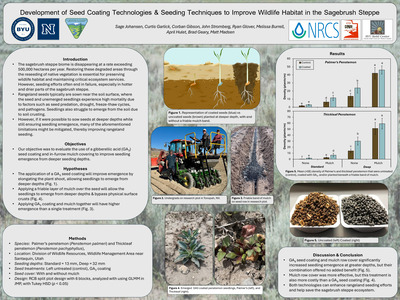
Development of Seed Coating Technologies & Seeding Techniques to Improve Wildlife Habitat in the Sagebrush Steppe
Sage Johansen, Curtis Garlick, Corban Gibson, John Stromberg, Ryan Glover, Melissa Burrell, April Hulet, Brad Geary, and Matt Madsen
Honorable Mention - Poster Design
- The sagebrush steppe biome is disappearing at a rate exceeding 500,000 hectares per year. Restoring these degraded areas through the reseeding of native vegetation is essential for preserving wildlife habitat and maintaining critical ecosystem services. However, seeding efforts often end in failure, especially in hotter and drier parts of the sagebrush steppe.
- Rangeland seeds typically are sown near the soil surface, where the seed and unemerged seedlings experience high mortality due to factors such as seed predation, drought, freeze-thaw cycles, and pathogens. Seedlings also struggle to emerge from the soil due to soil crusting.
- However, if it were possible to sow seeds at deeper depths while still ensuring seedling emergence, many of the aforementioned limitations might be mitigated, thereby improving rangeland seeding.
-

Rapid Kitchen Compost as a Growing Media
Rebecca Kerr, Shannon V. Nelson, and Bryan G. Hopkins
ReencleTM composters decompose most food waste within 24 hours (~90% reduction).
Compost can be an excellent source of nutrients for plants and improve soil structure and water retention.
Objective: Determine the effectiveness of kitchen compost as a soil amendment for growing lettuce (Lactuca sativa L.), and Cucumber (Cucumis sativus L.).
-

Meta Analysis of the Riverine Barrier Hypothesis in Mainland Southeast Asia
Gavin Kohl, Christian Furness, Eleanor Savage, Perry Van Wagoner, and Randy Klabacka
Understanding the drivers of biodiversification is an important objective in evolutionary biology
Yet much is still unknown regarding the mechanisms that drive biodiversity in species
Identifying barriers between lineages is a viable approach to discovering potential drivers
-

Iron Nutrition in Hydroponically Grown Quinoa
Ezra A. Larsen, Daniel L. Lamb, Shannon V. Nelson, Geneva M. Bell, and Bryan G. Hopkins
- Iron (Fe) deficiency is a global health challenge
- Fe is an essential plant nutrient and limiting factor for many food crops
- Quinoa (Chenopodium quinoa Willd.), a nutrient dense pseudocereal, is of growing importance for food security
- Quinoa is often grown in alkaline soil, where Fe is particularly limiting
- An improved understanding of how Fe affects quinoa growth could improve yields and help increase dietary iron intake
-

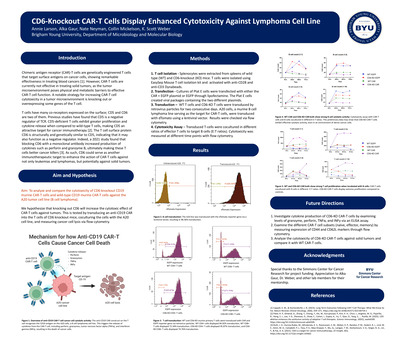
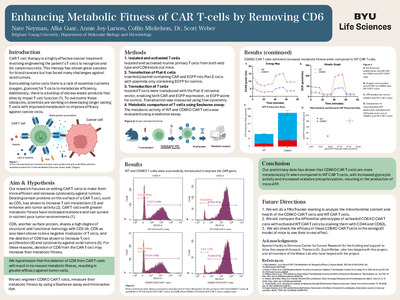
CD6-Knockout CAR-T Cells Display Enhanced Cytotoxicity Against Lymphoma Cell Line
Annie Larson, Alka Gaur, Nate Neyman, Collin Mickelson, and K. Scott Weber
Chimeric antigen receptor (CAR)-T cells are genetically engineered T cells that target surface antigens on cancer cells, showing remarkable effectiveness in treating blood cancers [1]. However, CAR-T cells are currently not effective in treating solid tumors, as the tumor microenvironment poses physical and metabolic barriers to effective CAR-T cell function. A notable strategy for increasing CAR-T cell cytotoxicity in a tumor microenvironment is knocking out or overexpressing some genes of the T cell.
-

Investigating the Mechanisms of Yersinia Ruckeri Inhibition by a New Strain of Pseudomonas Fjordensis
Kyler Linton and David Erickson
Pacific freshwater fish are less likely than Atlantic freshwater fish to exhibit Enteric Redmouth Disease (ERM), or Yersiniosis as caused by Yersinia ruckeri. Based on the hypothesis that these fish may harbor commensal bacteria that inhibit Y. ruckeri growth, I isolated many kinds of commensal bacteria from fish intestines collected from Alaska and local streams. In previous studies, I have isolated novel bacteria capable of expressing inhibitory activity against Y. ruckeri via co-culture experiments. One of these bacteria is a strain of Pseudomonas fjordensis. Through genome-wide mutagenesis techniques, a possible gene has been unveiled that may be contributing to this inhibitory activity.
-

C-FMS Expresses in Early Progenitor Cells & Myeloid-Lineage Leukocytes Based on Analyzing Lineage Markers and Mapping on Ly6C x CD31 Plots in Bone Marrow
Jane Lundgren, Kelly Amsden, Evan Boesl, Victoria Hall, Emily Shakespear, Pam Van Ry, and Sandra Hope
The Mafia mouse model expresses the green fluorescent protein (GFP) in cells that utilize the macrophage-specific c-fms promoter. The c-fms promoter controls expression of receptor for Colony Stimulating Factor 1. We hypothesize that this promotor may be utilized in bone marrow progenitor cells in addition to the mature cell expression already known in macrophage lineage cells. For this study, bone marrow cells were analyzed by flow cytometry for the expression of c-fms, early progenitor markers, and lineage-specific markers. Expression was also mapped on a Ly6CxCD31 plot, which has been used to distinguish cells based on developmental stage and lineage. This was used to visualize the developmental pathways of the bone marrow. Experimental findings provide a clearer framework for tracking hematopoiesis and specific lineage progression and confirm the utility of c-fms as a developmental marker in conjunction with the Ly6CxCD31 plot.
-

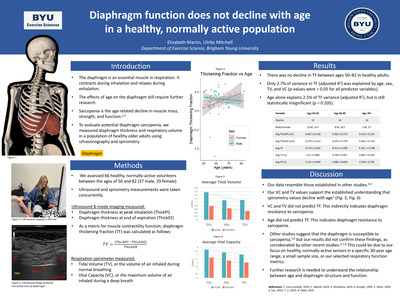
Diaphragm Function Does Not Decline With Age in a Healthy, Normally Active Population
Elizabeth Martin and Ulrike Mitchell
3rd Place - Poster Design
- The diaphragm is an essential muscle in respiration. It contracts during inhalation and relaxes during exhalation.
- The effects of age on the diaphragm still require further research.
- Sarcopenia is the age-related decline in muscle mass, strength, and function.1,2
- To evaluate potential diaphragm sarcopenia, we measured diaphragm thickness and respiratory volume in a population of healthy older adults using ultrasonography and spirometry.
Printing is not supported at the primary Gallery Thumbnail page. Please first navigate to a specific Image before printing.