
The Annual Mary Lou Fulton Mentored Research Conference showcases some of the best student research from the College of Family, Home, and Social Sciences. The mentored learning program encourages undergraduate students to participate in hands-on and practical research under the direction of a faculty member. Students create these posters as an aide in presenting the results of their research to the public, faculty, and their peers.
If you are submitting your poster, please do so via the Submit Research link in the left sidebar on this page, and not on the main Submit Research page.
































-
Greenway Systems in Salt Lake City and Tallahassee A Comparitive Analysis
Derek Bruton, Lydia Michela, Tyler Terry, and Morgan Osborne
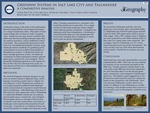
Landscape ecology is the study of the relationship between spatial pattern and ecological processes on a range of landscape scales. One aspect of land¬scape ecology that we chose to study was green¬ways. Greenways are long, narrow corridors that differ from the surrounding landscape types; they are used for recreation, and for pedestrian and bi¬cycle traffic. We compared the greenways in Salt Lake City and Tallahassee (Figures 3 and 4), using landscape metrics (methods of quantifying land¬scape pattern) as tools to define characteristics of the greenway systems. To determine which city had a stronger greenway system, we based our conclusions on three comparative metrics: percent green space, connectivity, and contagion. We ex¬pected the Tallahassee greenway to be superior to that of Salt Lake City’s because of its warm, hu¬mid climate and the city’s well-established plan for greenway expansion.
-

Modeling Large-Scale Historical Migration Patterns Using Family History Records
Brian Bunker, Elias Wise, Eric Severson, and Sam Otterstrom
Location has a powerful effect, and humans seek to understand not only where they are, but where they have come from. Thus, genealogy and migration are both important human concepts, and one can help to illuminate the other. Historical migration studies use records of all types to attempt to model and explain the movement of individuals and families. Our purpose is to use the new Family Search database compiled by the Church of Jesus Christ of Latter-day Saints and its members to create a flexible search engine which will enable visualization and analysis of migration by community or by place of orig, and which will explore the dynamics of multigenerational migration.
-
Predictors and Outcomes of Work-Family Conflict: A U.S. and Singapore Cross-Cultural Comparison
Lydia A. Buswell, Adam M. Galovan, Tamara A. Fackrell, and Blake L. Jones
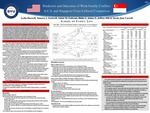
This paper examines the predictors and outcomes of work-family conflict in a cross-cultural comparison between nationally-representative samples from the United States (N = 1870) and Singapore (N = 1035). As expected, schedule flexibility was positively related to mental health in the United States, but in Singapore the relationship was negative. Likewise, work-to-family conflict was negatively related to marital satisfaction in the United States, however, it was positively related to marital satisfaction in Singapore. Similarly, family-to-work conflict was positively related to job satisfaction in United States, but was negatively related in Singapore. The findings suggest that theoretical relationships in the work-family interface developed in the individualistic West may need to be adapted when studying populations in the collectivist East.
-
Theoretical Treasure Untapped: Sociology’s Neglect of Friedrich Nietzsche
Meghan Butcher and Howard Bahr
Q1-How might Nietzsche’s work benefit sociology? Q2-To what extent is Nietzsche already represented in the sociological tradition? Q3-How have sociologists responded to Antonio’s (1995) plea that we consider him a founder? Q4-How does sociological usage compare with that of other disciplines? Q5-What are our options and opportunities?
-

Facebook and Self-worth
Dallin Bywater, Chelsey Tautkus, Paul Moss, and Dana Kearnes
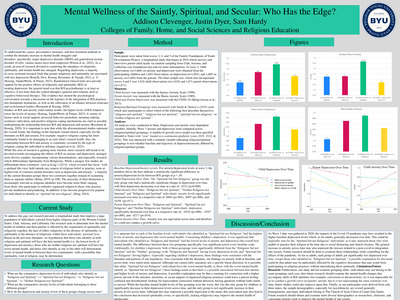
It is already known that self-worth can be easily manipulated and diminished by disparagement. In response to this disparagement, one will then seek social gratification from their peers, which will work to bolster their damaged self-worth. One of the easiest ways for these disparaged people to seek social gratification is through Facebook use. However, it is not yet known if a decrease of self-worth leads to an increase in Facebook usage; if this relationship indeed exists, then we may be able to understand more about the link between self-worth and social networking. For example, it is possible that poor mental health causes people to more intensely use Facebook. Testing our theory adds to our understanding of how external validation of self-worth relates to Facebook usage. We have hypothesized that decreasing self-worth will cause intensity of Facebook usage to increase.
-
Parent-Adolescent Attachment as a Mediator of Relations between Parenting and Adolescent Social Behavior and Well-Being in China
Mengfei Cai, Blake Hudson, Ashley Maag, and Sam Hardy
The study of adolescents’ attachment to parents and its relation to adolescents' well-being has received increasing attention in recent years. But the mechanic in this relation and even in the whole working pattern is still not very clear---not only in western background, but also in eastern culture. This study examined how parenting dimensions (authoritative, psychological control, and over-protecting) relate to adolescent outcomes (self-esteem, autonomy, and peer relationships) by way of parent-teen attachment, among Chinese families.
-
Hanging Out Among Latter-day Saint Young Adults: A Qualitative Study
Matthew Call, Michael Richards, and Tom B. Holman
Latter-day Saint (LDS) Church leaders have recently counseled LDS young adults to avoid substituting the practice of hanging out for dating (Oaks 2006, Wickman, 2010). In the face of this counsel, hanging out continues to be a common occurrence. The present study was conducted to better understand why hanging out occurs, how young adults conceptualize it, and what function it serves as a potential pathway to marriage. We believe that hanging out serves two different functions, distinguishable by the intentions of participants and time commitments involved. We have termed “purposive” hanging out as being used to locate and filter potential dating partners, and “non-committal” hanging out as being used to fill needs for companionship and recreation with mixed gender groups.
-

Income and Health Outcomes: Revisiting the Income-Health Gradient
Craig H. Carter and Mark Showalter
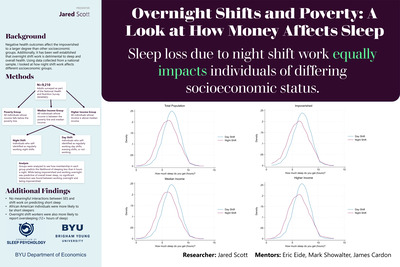
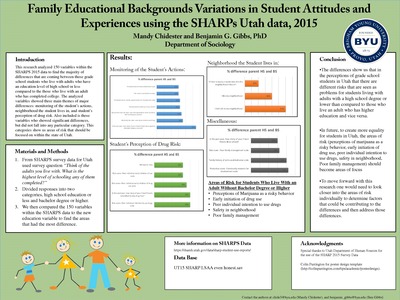
Much of the current debate surrounding health care is centered on the perception that the socio-economically disadvantaged are less healthy than their richer counterparts. This idea, known as the income-health gradient, has been studied heavily in the academic literature and this poster is an update of one such study conducted by Case et al. in 2002. In their study, the researchers found that those with lower incomes also have lower self-reported health scores, and that this relationship not only persists, but actually worsens, as people get older. Using updated data, I found that this problem is still very prevalent in our society today, and a dilemma that has serious policy implications. To conclude my research, I conduct a simple cost-benefit analysis aimed at identifying the most plausible remedies for the income-health gradient.
-
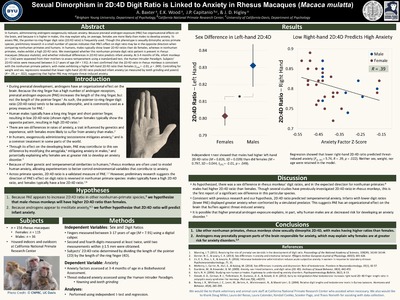
Temperamental behaviors measured during the first months of life are predictive of aggression in group housed rhesus macaques (Macaca mulatta)
Andrew C. Chaffin, Christina S. Barr, and James D. Higley
Temperament is thought to be the foundation for personality and subsequent behaviors later in life. To assess early temperamental variables that place individuals at risk for aggression later in life, this laboratory-based study examined infant behavior in group housed infant rhesus macaques (Macaca mulatta). The subjects were 52 mother-reared subjects. Behavior was assessed from the first through the eighth months of life using objective behavioral measures. Two 5-minute sessions were recorded for subjects each week over 8 months and the average rate of each of the 25 behaviors measured was the dependent measure. A test of the same subjects 2-4 years later measured the dependent variable, aggression, using the Fairbank’s Intruder Challenge Test, when subjects were 3-5 years of age. Results: Four behaviors exhibited a statistically significant ability to predict aggression. Statistically significant correlations were found for activity-oriented behaviors of environmental exploration, approach by infant, and leave by infant, as well as the social variable, socialize with individuals other than mother, with a modest positive r-value between .273 and .357. This activity-oriented trait may reflect hyperactive tendencies that have been shown in humans to increase the risk for aggression. This study suggests that objective measurements of activity levels in infant rhesus monkeys can be a predictive variable in determining later levels of aggression.
-
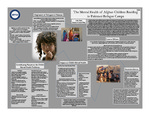
The Mental Health of Afghan Children Residing in Pakistani Refugee Camps
Kelli Child and Jini Roby
There have been several different events in Afghanistan's history that have forced its citizens to find refuge amongst its neighbors, the largest amount settling in Pakistan. As one of the largest groups of refugees currently, there are countless hardships that these individuals face. While struggling to find a place to meet their basic necessities, they meet untold hardships even within themselves--‐ coping with the stress, trauma and inevitable effects of being drenched in war--‐torn surroundings. There are political, economic, familial, cultural and individual contributing factors that inevitably have an effect upon their mental health. As with any population, the children are the hardest hit, and most often neglected. There are serious mental health problems found in the Afghan refugee children, most commonly post-traumatic stress disorder (PTSD). A child's mental health is highly dependent on the security of their surroundings and parents' well--‐being, which often-times itself is crumbling or absent. While there are many laudable efforts currently to help the refugees, endeavors to address the mental Health of their children has been few and far between. It is highly recommended to move forward by establishing a secure environment for the child by: recognizing the seriousness and widespread nature of mental illness, reducing the amount of exposure to violence, and moving forward by refortifying, reviving and rallying the family and feeling of community to once again provide the support and treatment that their children need.
-
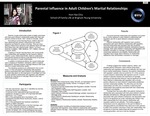
Parental Influence in Adult Children’s Marital Relationships
Hsin-Yao Chiu and Jenet Jacob
Parents’ couple relationship quality is highly associated with their adult children’s relationship quality with their own partners (Amato & Booth, 2001; Amato & Cheadle, 2005). According to social learning theory, children discover from observing their parents’ interactions that certain behaviors are linked to certain outcomes. They are more willing to follow those behaviors and attitudes which will help them attain their own desired goals (Akers, La Greca, Cochran, & Sellers, 1989; Bandura, 1977; Sellers, Cochran, & Branch, 2005). Drawing on Social Learning theory, the current study uses relationship self-regulation as the measure (Wilson, Charker, Lizzio, Halford and Kimlin, 2005) to understand how specific behavioral efforts could effectively bring about positive outcomes in couple relationships. In addition to behavioral efforts, the current study also uses a measure of “familism” (Schwartz, 2007) to explore how parents’ attitudes towards marriage influence their adult children’s couple relationship quality. The following questions are addressed in the current study: (1) How are parents’ relationship self-regulation patterns associated with adult children’s self regulation and the value they place on the importance of marriage? (2) How do adult children’s relationship self-regulation and attitudes towards the importance of marriage influence their own relationship quality?
-
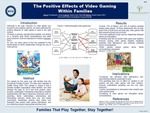
The Positive Effects of Video Gaming Within Families
Maren K. Christiansen, Sarah Lewis, Jesse Croskrey, and Meredith Mehner
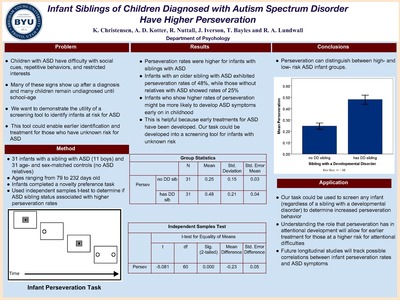
Although in the past, research on video games has focused on the negative aspects, our study examines the positive influence of video games if used in the right context. Though co-playing, spending time together, and aiming for a common goal, family connectedness and other good outcomes could be expected to increase (Aarsand, 2007). In sum, our study seeks to find any potential for the enhancement of family relationships through the use of video games.
-

Symbols of the French Revolution
Bill Cichoski, Angela Rice, Philip Greenan, and Elisa Visick
During the French Revolution, France as a nation did not exist yet. There were many different ethnic and linguistic groups that had to be united in order to form the France that we know today. To bridge the divide between the different regions of France and the different classes involved in the Revolution, symbols were used to convey certain ideals. The liberty cap, the tricolor flag, Marianne, and other symbols became important in the spread of Revolutionary ideas. Our research aims to show that these symbols served an important role in creating a national identity in France.
-

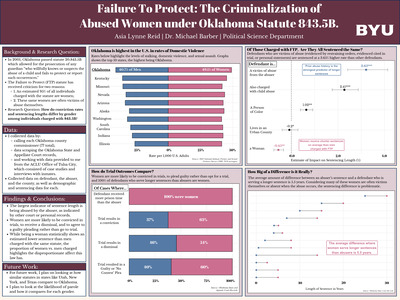
To Stay or to Leave: Factors Which Predict Women's Tolerance of Abusive Relationships
Melinda Cook, Lauren Woodward, and Bert Burraston
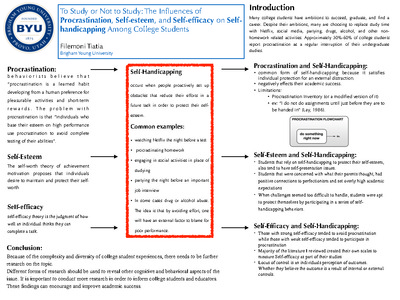
This study focuses on domestic violence victimization, specifically partner abuse towards women. Domestic violence is a major problem in the United States with far reaching consequences. Some estimates have shown that nearly 2 million women in the United States are severely assaulted by their significant others each year. A major problem that researchers face is, why do these women stay? If they are in an abusive relationship, why would they not end it? There is no definitive answer presented in prior research as to why women choose to leave or to stay in abusive relationships. This study seeks to identify characteristics among abused women that allow women to end abusive relationships, so that initiatives may be taken to provide women with the skills or resources necessary to leave abusive situations when they wish to do so.
-
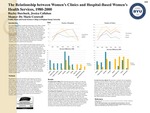
The Relationship between Women’s Clinics and Hospital-Based Women’s Health Services, 1980-2000
Hayley R. Darchuck, Jessica Callahan, and Marie Cornwall
The United States women’s health movement began in the 1960s as women throughout the country decided to take control of their bodies and their health care in the form of women’s clinics. These clinics were based on “for women, by women” health care, emphasizing self help, education and birth control. Since the creation of clinics, their growth has appeared to fluctuate substantially by the effects of outside factors such as presidential impacts and antiabortionist vandalism. For example, during the Reagan administration, funding for women’s clinics decreased due to staunch “Reaganomics,” and block funding (Morgen2002) and later increased after Clinton’s entrance into office due to his more liberal tax policies (Moss 1996). Further, many clinics floundered financially due to increased vandalism costs from antiabortionist defacement. Throughout this time, women became the major health consumers in the United States. In 2002, for example, women controlled 66% of health care spending in the country, being responsible for both the health needs of themselves and of their families (Scalise2003). Hospital administrators appeared to recognize that if they enticed women into their hospitals to seek medical care, the women would also bring their sick family members. This led to the co-optation of women’s health care and the shift in women’s care from clinics into hospitals. This shift also inspired the change from traditional feminist clinic services offered, such as abortion and birth control, to the new services offered by hospitals today, such as mammography, plastic surgery, and mental health treatments (Thomas and Zimmerman 2007). Because of the increased marketing opportunities for hospitals, we hypothesized that there would be a visual relationship between women’s health care services offered in clinics as compared to hospitals. We hypothesized that our findings would reflect a general trend of decrease in clinics and subsequent increase in hospital numbers. We also proposed that the services offered in 2000, in both clinics and hospitals, would substantially differ from those offered in 1980, including an increased number of services offered and a variety of “new” services entering the women’s health market.
-
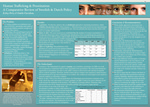
Human Trafficking and Prostitution: A Comparative Review of Swedish and Dutch Policy
Emilie Davidson, Kelsey Perry, and Jini Roby
1.2 million children are trafficked every year (UNICEF), and and the total number of prostituted children could be as high as 10 million (The Lancet). Trafficking is the second largest source of illegal income worldwide, exceded only by the sale of illegal drugs (Belser, 2005). A study of women trafficked to the European Union found that 95% of victims had been violently assaulted or coerced into a sexual act, and over 60% of victims reported fatigue, neurological symptoms... back pain, vaginal discharges, and gynecological infections (Zimmerman, 2006). Definitions: Trafficking refers to “the recruitment, transportation, transfer, harbouring or receipt of persons, by means of the threat or use of force or other forms of coercion... for the purpose of exploitation,” whereas prostitution refers to the sale of sex (UN, 2010).
-
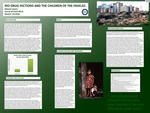
Rio Drug Factions and the Children of the Favelas
Melanie Davies and Jini Roby
Rio de Janeiro, among other major cities in Brazil, has been surrounded with slums for over a hundred years. These slums, called favelasby the natives, began springing up in the 1850’s (Gay, 1994). Many people migrated to the city in search of a better life. Unable to afford a home, they built shelters on the illegally claimed hillsides of Rio de Janeiro, intending to improve their situation from there (Villareal & Silva, 2006). Instead, the number of favelas has drastically increased over the years. In Rio de Janeiro alone, there are currently over 1800 favelas housing about 2 million people, or one third of the population of Rio (Frayssinet, 2007a). Though stricken with poverty, the favelas became a place of culture and laughter. Festivities in the favelas would bring people from all over the city (Neate & Platt, 2006). Meanwhile, as the government completely ignored the plight of the favelas, drug gangs began to move in and take over. They took care of the favelados, or people of the favelas, and kept peace within the community; something the government had never done for them. However, over time the rule of the drug factions became much harsher and more violent (Neate & Platt, 2006). In 2006, the murder rate in Rio de Janeiro was 37.7 murders per 100,000 inhabitants, most of the victims being between 15 and 24 years of age and related to the drug trade in the favelas (Michel, 2008; Iyer, 2004). Comparatively, the murder rate in 2006 for the whole United States was 8.7 murders per 100,000 people (Federal Bureau of Investigation [FBI], 2010). The violence brought to the favelas by the drug factions has become a major problem in Rio de Janeiro, especially in the impact it has had on children and teenagers in the favelas.
-

Police Inspired Crime: The Effect of Corruption on Crime
Taryn W. Davis, Jeffrey Pett, and Stephen Bahr
Criminal behavior can be caused by strain produced from confrontation with negative stimuli. Corruption of public officials can act as a negative stimuli which creates anger and strain on the general public and leads to an increase in criminal behavior.
-
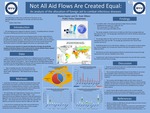
Not All Aid Flows Are Created Equal: An analysis of the allocation of foreign aid to combat infectious diseases
Shane W. Dayton and Sven Wilson
The developing world is plagued by infectious diseases. Controlling infectious diseases will reduce suffering and promote economic development. Foreign aid donors fund projects for developing countries to help combat infectious diseases. However, foreign aid is not always allocated based on need. Often, it is given for political and strategic reasons1. With respect to aid for the health sector, the research has focused primarily on the global-disease level and not on the country-disease level. The limited research on the latter suggests that donors are responding to need2. The focus of my research is to examine the allocation of foreign aid specifically targeted at infectious diseases at the country-level to evaluate whether donors respond to countries’ level of need (as measured by disease burden).
-
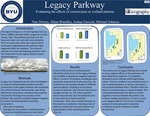
Legacy Parkway: Evaluating the effects of construction on wetland patterns
Nate Dorsey, Jillian Brandley, Joshua Fawcett, and Michael Johnson
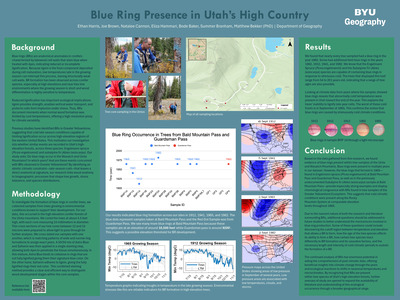
The Legacy Parkway is a 14-mile highway that was built in 2008 to alleviate traffic congestion in Davis County, Utah. The parkway was built near the Great Salt Lake in an area with many wetlands. Prior to construction there was a great deal of controversy regarding how the parkway might negatively affect the wetlands. This research attempts to answer the following question: How did construction of the Legacy Parkway impact wetland patterns?
-
Measuring Father Involvement with adolescents in Botswana
Kerianne Dyer and Jini Roby
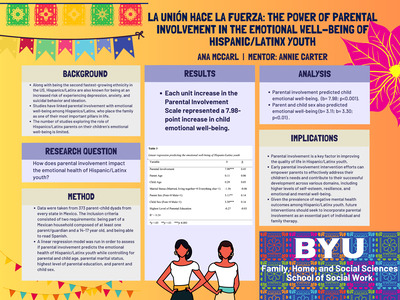
Emerging research suggests that father involvement is a multifaceted concept, often driven by cultural mandates. In this study, survey data were collected from 704 adolescents aged 14-16 in Botswana. Fathers who provided both co-residence and financial support were perceived at the highest level of involvement. When considered separately, financial support rather than co-residence was associated with higher levels of perceived father involvement. Maternal gate keeping was also found to be a significant influence on perceived levels of father involvement. Implications for policy, practice and research are discussed.
-
Grandparent/Grandchild Relationship: Linking Grandparent Involvement to Adolescent Pro-social Behaviors
Corey Ellis, Marinda Quist, Ruth Robinson, and Dara Peterson
Due to the changing dynamics of family life, there is a current need to understand the grandparent-grandchild relationship. Grandparents today are more involved in the lives of their grandchildren because of increased life expectancy, divorce rates, and dual working homes (Attar-Schwartz, Tan, & Buchanan, 2009).We examined how grandparents’ financial involvement with the family and their emotional closeness to the adolescent (Kemp, 2005) impacts behavioral outcomes. One study shows that a negative grandparent-parent relationship will negatively affect the grandparent-grandchild relationship (Attar-Schwartz, S., Tan, J., & Buchanan, A, 2009). We hypothesize that the financial support of grandparents, grandparent emotional closeness with their grandchildren, and the strength of the grandparent-parent relationship all lead to pro-social outcomes. We define pro-social behavior as positive interactions with strangers.
-
Evidence of Opinion: A Critical Analysis of the Use of Empirical Literature in Controversial Topics
David Erekson, Sasha Mondragon, Kiley DeLange, and Amelia Leetham
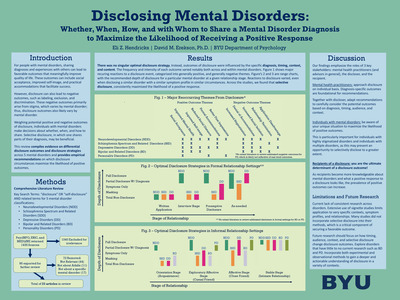
The American Psychological Association (APA) and the National Association for Research and Therapy of Homosexuality (NARTH) use the same empirical sources as supporting evidence for differing views on the psychological treatment of sexual minorities. Given this discrepancy, we undertook a critical analysis of all sources commonly cited by APA and NARTH. We conclude that the sources have not been used consistently, and that this may be a product of differing beliefs surrounding a controversial issue.
-

Predictors of Performance Monitoring Abilities following Traumatic Brain Injury: The Influence of Negative Affect, Cognitive Dysfunction, and Injury Severity
Joseph E. Fair and Michael J. Larson
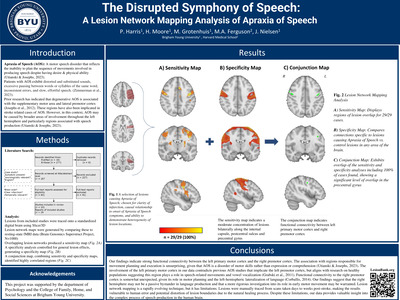
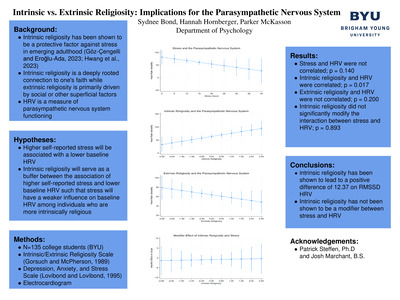
Survivors of severe traumatic brain injury (TBI) often demonstrate impairments in cognitive control and performance monitoring. Performance monitoring is a cognitive control process modulated by both cognitive and affective variables. Performance monitoring functions can be evaluated using the error-related negativity (ERN) and post-error positivity (Pe) components of the event-related potential (ERP).
-
Does Democracy in the Home Create Democracy in the Nation?
Aimee Farnsworth and Valerie Hudson
While the rise of liberal democracy has usually been linked to the growth of capitalism and the rise of the bourgeoisie, a fairly new theory claims that democracy in the state began with democracy in the home (Hajnal1982; Hartman 2004). That is, as the relationship between husband and wife became more equal, a mini-democracy was created in the home which promoted liberal democracy on a larger scale, first in the community, and then the nation. Those promoting democracy might therefore find it beneficial to first, or at least concurrently, promote equality between husband and wife. Increased equality between spouses will not only allow families to flourish, but communities and nations as well. This project is a preliminary examination of the supposed causal relationship between democracy in the home and democracy in the nation.