
Files
Download Full Text (2.8 MB)
Keywords
Crime, Exoneration, Wrongful Conviction, Poverty, Education, Index, Non-English Speaking, Law, Spatial, Analysis
Abstract
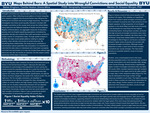
Wrongful convictions are representative of errors in the criminal justice system. Often reflecting broad patterns of social inequality, prior research suggests that structural factors may influence the likelihood of conviction and access to legal resources. This project investigates how these social equality indicators correlate with wrongful convictions at the county level across the United States. Using data from the National Institute of Health and the National Registry of Exonerations, we aggregate measures of education, poverty, and non-English-speaking populations normalized by population density and combine them with exoneration records to create a series of comparative maps. Through spatial analysis in ArcGIS, the maps reveal spatial patterns relating to regional poverty, urban density, and access to social resources. By visualizing these relationships, this study aims to contribute to conversations about systematic bias and justice. It is important to note that this data relies on individuals who have been wrongfully convicted and exonerated, so it may not include those without legal resources who did not receive an outcome. For this reason, further awareness of this topic is necessary.
BYU ScholarsArchive Citation
Kinghorn, Bailee; Milne, Emma; and Heaton, Camille, "Maps Behind Bars: A Spatial Study into Wrongful Convictions and Social Equality" (2026). FHSS Mentored Research Conference. 404.
https://scholarsarchive.byu.edu/fhssconference_studentpub/404
Document Type
Poster
Publication Date
2026-04-03
Language
English
College
Family, Home, and Social Sciences
Department
Geography
Course
GEOG 311
Copyright Use Information
https://lib.byu.edu/about/copyright/