
Files
Download Full Text (904 KB)
Keywords
sex assigned at birth, gender identity, transgender, cisgender, non-binary, TGNB, AFAB, AMAB, gender expression, perceived hireability
Abstract
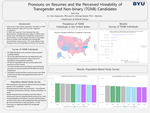
Transgender and non-binary (TGNB) individuals are more likely to be in poverty and be unemployed than cisgender individuals. This study seeks to understand if placing one’s pronouns on their resumes creates a barrier to equal employment for the TGNB population. I do so through two means: surveying TGNB individuals (n=63) on their worries and experiences with placing their pronouns on their resumes and conducting an RCT (n=654). The RCT assigned participants to 1 of 8 pronouns which shared all information save the candidates’ name (either masculine or feminine) and pronouns (he, she, they, or no pronouns). I find that TGNB individuals worry about including pronouns on their resumes and that doing so could create employment barriers to non-binary individuals. Results indicated that those using they/them pronouns were most likely to worry about gender identity-based discrimination; treatments using they/them pronouns were most likely to be rated negatively by RCT participants. I provide several recommendations for further research and policy implications, including the codifying and enforcing of Bostock v. Clayton County.
BYU ScholarsArchive Citation
Ririe, Seth, "Pronouns on Resumes and the Perceived Hireability of Transgender and Non-binary (TGNB) Candidates" (2023). FHSS Mentored Research Conference. 379.
https://scholarsarchive.byu.edu/fhssconference_studentpub/379
Document Type
Poster
Publication Date
2023-12-07
Language
English
College
Family, Home, and Social Sciences
Department
Political Science
Course
POLI 410 - Capstone in American Politics
Copyright Use Information
http://lib.byu.edu/about/copyright/